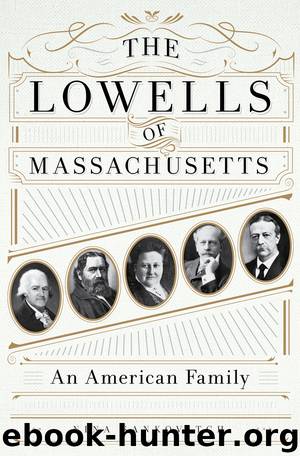
The Lowells of Massachusetts by Nina Sankovitch
Author:Nina Sankovitch
Language: eng
Format: epub
Publisher: St. Martin's Press
18
1853–1861
Though the cause of Evil prosper, yet ’tis Truth alone is strong,
And, albeit she wander outcast now, I see around her throng
Troops of beautiful, tall angels, to enshield her from all wrong.
—JAMES RUSSELL LOWELL, “THE PRESENT CRISIS”
Before Maria Lowell died, James Russell Lowell had been invited by his cousin John Amory Lowell to prepare a series of lectures for the Lowell Institute. Over the past thirteen years the institute had grown, gathering fame and reputation not only for audiences eager to learn from a wide array of speakers but also for lecturers keen to be invited to appear. Evenings at Marlboro Chapel on Washington Street, where the lectures were held, most often sold out (tickets were free but had to be reserved) due to the astute planning of the institute’s sole trustee, John Amory. He provided lecturers that were well known in their field, and he ensured a broad range of fields were represented: Thomas Nuttall on botany, Jospeh Lovering on electricity and electromagnetism, Jared Sparks on American history, Orville Dewey on the “Problem of Human Destiny.”
Having managed the endowment of the institute as well as he managed his own money, John Amory Lowell had plenty of funds to pay for eminent speakers to come from far away, and to pay them well enough to make the visit attractive. Often, the guest lecturers were invited to stay out at Bromley Vale as guests of John and his wife, Elizabeth. Louis Agassiz, the Swiss biologist who gave his first lectures at the institute in 1846 and then became a professor at Harvard, was so frequent a visitor that he became quite at home at Bromley Vale. He used the maids’ “pincushions as butterfly mats,” requisitioned household water jugs to hold his newly picked specimens of local ferns, and claimed dresser drawers as temporary homes for what the servants called “the professor’s little beasts.” One morning, the household came to a standstill when they heard Mrs. Agassiz shrieking, “Louis, there is a snake in my shoe!” He answered calmly, although setting off panic in all listeners, “Only one snake, my dear? Why, where’s the other? There were two!”1
After Maria died, John Amory again urged Jamie to work on lectures for the institute. Jamie’s situation—losing his children and his wife—mirrored the situation of their cousin John junior—the son of Francis Cabot Lowell—who had lost his daughters and wife in a relatively short period of time. No one in the family wanted Jamie running away to Egypt as John junior had done or rotting away on his own in the attic at Elmwood. It was up to John Amory Lowell to offer his cousin a new opportunity, and all the Lowell family prayed that he would take it.
Jamie felt “very unhappy,” and very lonely, living with his father—“perfectly deaf”—and his sister—“who never speaks for a week together.” He found joy in the presence of Mabel—“my nature is naturally joyous and susceptible of all happy impressions”—and yet still the tears came: “I have found the secret of them and something seems to catch in my throat as I am writing.
Download
This site does not store any files on its server. We only index and link to content provided by other sites. Please contact the content providers to delete copyright contents if any and email us, we'll remove relevant links or contents immediately.
| Africa | Asia |
| Canadian | Europe |
| Holocaust | Latin America |
| Middle East | United States |
Fanny Burney by Claire Harman(26579)
Empire of the Sikhs by Patwant Singh(23057)
Out of India by Michael Foss(16837)
Leonardo da Vinci by Walter Isaacson(13287)
Small Great Things by Jodi Picoult(7099)
The Six Wives Of Henry VIII (WOMEN IN HISTORY) by Fraser Antonia(5482)
The Wind in My Hair by Masih Alinejad(5069)
A Higher Loyalty: Truth, Lies, and Leadership by James Comey(4937)
The Crown by Robert Lacey(4783)
The Lonely City by Olivia Laing(4782)
Millionaire: The Philanderer, Gambler, and Duelist Who Invented Modern Finance by Janet Gleeson(4441)
The Iron Duke by The Iron Duke(4333)
Papillon (English) by Henri Charrière(4236)
Sticky Fingers by Joe Hagan(4167)
Joan of Arc by Mary Gordon(4076)
Alive: The Story of the Andes Survivors by Piers Paul Read(4009)
Stalin by Stephen Kotkin(3936)
Aleister Crowley: The Biography by Tobias Churton(3621)
Ants Among Elephants by Sujatha Gidla(3449)
